

Pokemon 3ds Red And Blue Bundle
| |
|---|---|
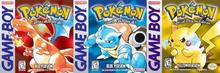 North American cover art for Pokémon Ruby-red, depicting Charizard, and Pokémon Blue, depicting Blastoise. The encompass fine art for Pocket Monsters: Light-green depicts Venusaur (not pictured). | |
| Developer(south) | Game Freak |
| Publisher(s) | Nintendo |
| Director(s) | Satoshi Tajiri |
| Producer(s) |
|
| Designer(south) | Satoshi Tajiri |
| Programmer(s) |
|
| Artist(s) |
|
| Writer(s) |
|
| Composer(s) | Junichi Masuda |
| Series | Pokémon |
| Platform(s) | Game Male child |
| Release |
|
| Genre(south) | Role-playing |
| Manner(s) | Single-player, multiplayer |
Pokémon Red Version and Pokémon Blue Version are 1996 part-playing video games developed by Game Freak and published past Nintendo for the Game Male child. They are the first installments of the Pokémon video game serial. They were showtime released in Japan in 1996 every bit Pocket Monsters: Red [a] and Pocket Monsters: Greenish ,[b] with the special edition Pocket Monsters: Bluish [c] beingness released in Japan afterward that same year. The games were later released equally Pokémon Cerise and Pokémon Blue in Northward America and Australia in 1998 and Europe in 1999. Pokémon Red and Pokémon Blue combined Red/Green/Blue for release outside of Nippon.
Pokémon Xanthous, an improved version, was released in Nippon in 1998 and in other regions in 1999 and 2000. Remakes of Red and Light-green, Pokémon FireRed and LeafGreen, were released for the Game Boy Accelerate in 2004. Red, Bluish, and Yellow–in add-on to Green in Japan–were re-released on the Nintendo 3DS Virtual Console service in 2016 as a commemoration of the franchise'south 20th anniversary.
The actor controls the protagonist from an overhead perspective and navigates him throughout the fictional region of Kanto in a quest to master Pokémon battling. The goal of the games is to become the champion of the Indigo League past defeating the eight Gym Leaders and and so the top 4 Pokémon trainers in the country, the Elite 4. Some other objective is to complete the Pokédex, an in-game encyclopedia, by obtaining the 151 available Pokémon. Ruby-red and Blue apply the Game Link Cable, which connects ii Game Male child systems together and allows Pokémon to be traded or battled betwixt games. Both titles are independent of each other but feature the same plot,[1] and while they can be played separately, it is necessary for players to trade between both games in gild to obtain all of the original 151 Pokémon.
Red and Blue were well-received with critics praising the multiplayer options, peculiarly the concept of trading. They received an aggregated score of 89% on GameRankings and are considered among the greatest games ever made, perennially ranked on superlative game lists including at least iv years on IGN 's "Top 100 Games of All Fourth dimension". The games' releases marked the start of what would become a multibillion-dollar franchise, jointly selling over 300 million copies worldwide. In 2009 they were alleged past IGN to be the "Best selling RPG on the Game Boy" and "Best selling RPG of all time".
Gameplay [edit]

Pokémon Red and Blue are played in a tertiary-person view, overhead perspective and consist of three bones screens: an overworld, in which the player navigates the primary character;[three] a side-view battle screen;[4] and a menu interface, in which the role player may configure their Pokémon, items, or gameplay settings.[5]
The actor can use their Pokémon to battle other Pokémon. When the player encounters a wild Pokémon or is challenged past a trainer, the screen switches to a turn-based battle screen that displays the two engaged Pokémon. During a boxing, the player may cull to fight using one of four moves, use an item, switch the agile Pokémon, or try to flee; notwithstanding, fleeing is not possible in trainer battles. Pokémon take hit points (HP); when a Pokémon's HP is reduced to zero, it faints and tin no longer battle until information technology is revived. In one case an enemy Pokémon faints, the histrion'due south Pokémon that were involved in the battle receive a certain number of experience points (EXP). After accumulating plenty EXP, a Pokémon will level up.[4] A Pokémon's level controls its physical properties, such equally the battle statistics acquired, and the moves information technology has learned. Some Pokémon may also evolve at certain levels. These evolutions touch the statistics and the levels at which new moves are learned. Pokémon at college stages of evolution gain more statistics each time they level up, although they may non learn new moves as early, if at all, compared with the lower stages of evolution.[6]
Catching Pokémon is another essential element of the gameplay. While battling with a wild Pokémon, the player may throw a Poké Ball at it. If the Pokémon is successfully defenseless, information technology volition come nether the player's ownership. Factors in the success rate of capture include the HP of the target Pokémon, whether it is under a status result, and the type of Poké Ball used: the lower the target's HP, and the stronger the status upshot and type of Poké Ball, the higher the success charge per unit of capture.[7] The ultimate goal of the games is to complete the entries in the Pokédex, a comprehensive Pokémon encyclopedia, by capturing, evolving, and trading to obtain all 151 creatures.[viii]
Pokémon Cerise and Blue allow players to trade Pokémon between two cartridges via a Game Link Cable.[9] This method of trading must be done to fully consummate the Pokédex since certain Pokémon will only evolve upon being traded and each of the ii games have version-exclusive Pokémon.[1] The Link Cable also makes information technology possible to battle some other player's Pokémon team.[nine] When playing Reddish or Bluish on a Game Boy Advance or SP, the standard GBA/SP link cablevision volition not work; players must use the Nintendo Universal Game Link Cable instead.[10] Moreover, the English versions of the games are incompatible with their Japanese counterparts, and such trades will decadent the save files, as the games use different languages and therefore character sets.[11]
As well equally trading with each other and Pokémon Yellow, Pokémon Red and Bluish can merchandise Pokémon with the second generation of Pokémon games: Pokémon Gold, Silver, and Crystal. Notwithstanding, there are limitations: the games cannot link together if ane histrion's party contains Pokémon or moves introduced in the second generation games.[12] As well, using the Transfer Pak for the Nintendo 64, data such as Pokémon and items from Pokémon Red and Blue tin be used in the Nintendo 64 games Pokémon Stadium [13] and Pokémon Stadium 2.[14] Red and Blue are incompatible with the Pokémon games of the later "Avant-garde Generation" for the Game Boy Accelerate and GameCube.[15]
Plot [edit]
Setting [edit]

Red, Green, and Blue take place in the Kanto region, based on Nihon's real Kantō region
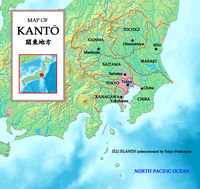
Map of Kantō region, Nippon
Pokémon Scarlet and Blue accept place in the region of Kanto, which is based on the real-life Kantō region in Japan. This is one distinct region, as shown in later games, with different geographical habitats for the 151 existing Pokémon species, along with homo-populated towns and cities and Routes connecting locations with one another. Some areas are simply accessible once the player learns a special ability or gains a special item.[16] Kanto has multiple locations: Pallet Town (マサラタウン Masara Town), Viridian Urban center (トキワシティ Tokiwa Urban center), Pewter City (ニビシティ Nibi Urban center), Cerulean City (ハナダシティ Hanada City), Vermillion City (クチバシティ Kuchiba City), Lavender Town (シオンタウン Cion Town), Celadon Urban center (タマムシシティ Tamamushi City), Fuchsia City (セキチクシティ Sekichiku City), Saffron City (ヤマブキシティ Yamabuki City), Cinnabar Isle (グレンじま Guren Island), Seafoam Islands (ふたごじま Twin Islands) and the Indigo Plateau. Each city has a gym leader, serving as the boss and the Elite Iv and final rival battle occur at Indigo Plateau. Areas in which the player tin can catch Pokémon range from caves to the sea, where the kinds of Pokémon available to take hold of varies. For example, Tentacool can just be caught either through angling or when the histrion is in a torso of water, while Zubat tin merely be caught in a cavern.
Story [edit]
The player begins in their hometown of Pallet Town. Later on venturing lonely into the tall grass, the player is stopped past Professor Oak, a famous Pokémon researcher. Professor Oak explains to the player that wild Pokémon may be living there and encountering them lonely can be very dangerous.[17] He takes the role player to his laboratory where the actor meets Oak'south grandson, a rival aspiring Pokémon Trainer. The player and the rival are both instructed to select a starter Pokémon for their travels out of Bulbasaur, Squirtle and Charmander.[18] Oak's Grandson will always choose the Pokémon which is stronger against the player'southward starting Pokémon. He volition so challenge the histrion to a Pokémon boxing with their newly obtained Pokémon and will proceed to battle the player at certain points throughout the games.[nineteen]
While visiting the region's cities, the player will encounter special establishments chosen Gyms. Inside these buildings are Gym Leaders, each of whom the player must defeat in a Pokémon battle to obtain a full of 8 Gym Badges. Once the badges are caused, the player is given permission to enter the Indigo League, which consists of the best Pokémon trainers in the region. There the player volition boxing the Elite Four and finally the new Champion: the thespian's rival.[20] Also, throughout the game, the player will have to battle against the forces of Team Rocket, a criminal organization that abuses/uses the Pokémon for various crimes.[vi] They devise numerous plans for stealing rare Pokémon, which the player must foil.[21] [22]
Evolution [edit]
Tajiri pitched the concept of Pokémon to Nintendo's staff in 1990[23] and was met with skepticism. They believed his ideas were as well ambitious and found it hard to see the appeal. Withal, Shigeru Miyamoto saw great potential in the thought and convinced the visitor to go ahead with the project.[24]
The initial concept for Pokémon stemmed from the hobby of insect collecting, a pop pastime which game designer Satoshi Tajiri enjoyed every bit a child.[25] While growing upwards, however, he observed more than urbanization taking place in the town where he lived and as a issue, the insect population declined. Tajiri noticed that kids at present played in their homes instead of outside and he came upward with the idea of a video game, containing creatures that resembled insects, called Pokémon. He thought kids could chronicle with the Pokémon by individually naming them, and then controlling them to correspond fear or anger equally a good manner of relieving stress. Notwithstanding, Pokémon never bleed nor die in boxing, only faint – this was a very touchy bailiwick to Tajiri, as he did not desire to farther fill the gaming earth with "pointless violence".[26]
When the Game Male child was released, Tajiri thought the organization was perfect for his idea, peculiarly because of the link cablevision, which he envisioned would allow players to merchandise Pokémon with each other. This concept of trading information was new to the video game industry because previously connection cables were only existence used for competition.[27] "I imagined a chunk of information existence transferred past connecting two Game Boys with special cables, and I went wow, that'south really going to be something!" said Tajiri.[28] Upon hearing of the Pokémon concept, Shigeru Miyamoto suggested creating multiple cartridges with different Pokémon in each, noting it would aid the trading attribute.[29] Tajiri was besides influenced past Square's Game Boy game The Terminal Fantasy Legend, noting in an interview that the game gave him the idea that more than just action games could be developed for the handheld.[30]
The main characters were named after Tajiri himself equally Satoshi, who is described equally Tajiri in his youth, and his long-time friend, role model, mentor, and beau Nintendo developer, Shigeru Miyamoto, as Shigeru.[26] [31] Ken Sugimori, an artist and longtime friend of Tajiri, headed the evolution of drawings and designs of the Pokémon, working with a squad of fewer than ten people who conceived the diverse designs for all 151 Pokémon. Atsuko Nishida created the designs for Pikachu, Bulbasaur, Charmander, Squirtle, and many others.[32] Sugimori, in turn, finalized each design, cartoon the Pokémon from diverse angles in order to assist Game Freak'southward graphics section in properly rendering the creature.[33] [34] Music for the game was equanimous by Junichi Masuda, who utilized the four sound channels of the Game Boy to create both the melodies and the audio furnishings and Pokémon "cries" heard upon encountering them. He noted the game's opening theme, titled "Monster", was produced with the image of battle scenes in mind, using white noise to sound similar marching music and imitate a snare drum.[35]
Originally called Capsule Monsters, the game's championship went through several transitions due to trademark difficulties, becoming CapuMon and KapuMon before eventually settling upon Pocket Monsters.[36] [37] Tajiri always thought that Nintendo would reject his game, as the company did not really understand the concept at first. However, the games turned out to be a success, something Tajiri and Nintendo never expected, especially considering of the declining popularity of the Game Male child.[26]
Tajiri said that the Poké Ball concept was inspired past Ultraseven's Capsule Monsters from the tokusatsu superhero television series Ultraseven (1967–1968).[38] Nintendo spent $13 million marketing Pokémon Red and Blueish in the United states.[39]
Music [edit]

Junichi Masuda equanimous the music for all versions
The music was composed by Junichi Masuda[40] at his home on a Commodore Amiga computer, which only features PCM sample playback, and converted to the Game Boy with a program he had written.[41]
Release [edit]
In Japan, Pocket Monsters: Red and Light-green were the first versions released, having been completed past October 1995 and officially released on Feb 27, 1996.[42] [43] They sold chop-chop, due in part to Nintendo'south idea of producing the ii versions of the game instead of a single title, prompting consumers to buy both.[28] Several months afterwards, Pocket Monsters: Blue was released in Nihon every bit a mail-club-only special edition[44] to subscribers of CoroCoro Comic on October 15, 1996. It was later released to full general retail on October 10, 1999.[45] [46] It features updated in-game artwork and new dialogue.[47] Using Blastoise as its mascot, the lawmaking, script, and artwork for Blue were used for the international releases of Red and Green, which were renamed to Red and Blue.[44] The Japanese Blue edition of the game features all just a scattering of Pokémon available in Red and Green, making sure Pokémon exclusive to the original editions.
To create more interest for the games, Tajiri revealed an actress Pokémon called Mew hidden inside them, which he believed "created a lot of rumors and myths near the game" and "kept the interest alive".[26] The creature was originally added by Shigeki Morimoto as an internal prank and was not intended to exist exposed to consumers.[48] It was non until later that Nintendo decided to distribute Mew through a Nintendo promotional consequence. Still, in 2003 a glitch became widely known and could be exploited so anyone could obtain the elusive Pokémon.[49]
During the Northward American localization of Pokémon, a modest team led by Hiro Nakamura went through the individual Pokémon, renaming them for western audiences based on their appearance and characteristics after approval from Nintendo. In addition, during this process, Nintendo trademarked the 151 Pokémon names in order to ensure they would be unique to the franchise.[50] During the translation process, it became apparent that only altering the games' text from Japanese to English was impossible; the games had to be entirely reprogrammed from scratch due to the fragile land of their source code, a side effect of the unusually lengthy evolution fourth dimension.[34] Therefore, the games were based on the more mod Japanese version of Blue; modeling its programming and artwork after Blue, but keeping the aforementioned distribution of Pokémon constitute in the Japanese Red and Light-green cartridges, respectively.[44]
As the finished Red and Blue versions were beingness prepared for release, Nintendo allegedly spent over fifty million dollars to promote the games, fearing the series would not exist appealing to American children.[51] The western localization team warned that the "cute monsters" may non be accepted by American audiences, and instead recommended they be redesigned and "beefed-up". So-president of Nintendo Hiroshi Yamauchi refused and instead viewed the games' possible reception in America equally a challenge to face.[52] Despite these setbacks, the reprogrammed Red and Blueish versions with their original creature designs were eventually released in North America on September 28, 1998, over 2 and a one-half years subsequently Red and Greenish debuted in Japan.[53] [54] The games were received extremely well past the strange audiences and Pokémon went on to become a lucrative franchise in America.[52] The same versions were after released in Commonwealth of australia former afterwards in 1998[55] and in Europe on Oct five, 1999[56] [57] existence the 2nd-to-last video game released for the original Game Boy in Europe with Pokemon Yellowish Version: Special Pikachu Edition beingness the last.
Pokémon Yellowish [edit]
Pokémon Yellow Version: Special Pikachu Edition ,[d] more commonly known as Pokémon Yellow Version , is an enhanced version of Red and Blueish, and was originally released on September 12, 1998, in Nippon,[58] [59] with releases in North America and Europe on October xix, 1999,[60] and June sixteen, 2000,[61] respectively. The game was designed to resemble the Pokémon anime series, with the player receiving a Pikachu as their starter Pokémon, and their rival starting with an Eevee. Some not-actor characters resemble those from the anime, including Team Rocket's Jessie and James.
Re-releases [edit]
During the November 12, 2015, Nintendo Direct presentation, it was announced that the original generation of Pokémon games would be released for the Nintendo 3DS Virtual Console service on February 27, 2016, the 20th ceremony of the games' original Japanese release. The games include a first for the Virtual Console: imitation Link Cable functionality to allow trading and battling betwixt games.[62] As was the instance with its original release, Green is exclusive to Japanese consumers.[63] These versions of the games are able to transfer Pokémon to Pokémon Sun and Moon via the Pokémon Bank application.[64]
A special Nintendo 2DS bundle was released in Japan, Europe, and Australia on February 27, 2016, with each console matching the corresponding color of the game version.[65] Northward America received a special New Nintendo 3DS packet with cover plates styled afterward Blood-red and Blueish 'south box art.[66]
Past March 31, 2016, combined sales of the re-releases reached 1.5 1000000 units with more than half being sold in Due north America.[67]
Reception [edit]
The games received more often than not positive reviews from critics, holding an amass score of 88% on GameRankings.[68] Special praise was given to its multiplayer features: the ability to trade and battle Pokémon with 1 another. Craig Harris of IGN gave the games a "masterful" 10 out of 10, noting that: "Even if you end the quest, y'all still might non have all the Pokémon in the game. The challenge to catch 'em all is truly the game's biggest draw". He besides commented on the popularity of the game, particularly amidst children, describing it equally a "craze".[1] GameSpot 's Peter Bartholow, who gave the games a "neat" eight.viii out of 10, cited the graphics and audio every bit somewhat primitive just stated that these were the games' merely drawbacks. He praised the titles' replay value due to their customization and diversity, and commented upon their universal appeal: "Under its cuddly outside, Pokémon is a serious and unique RPG with lots of depth and excellent multiplayer extensions. As an RPG, the game is attainable plenty for newcomers to the genre to enjoy, but it will entertain hard-cadre fans every bit well. Information technology's easily one of the best Game Boy games to date".[half dozen]
The success of these games has been attributed to their innovative gaming experience rather than audiovisual effects. Papers published by the Columbia Business School indicate both American and Japanese children prefer the actual gameplay of a game over special sound or visual effects. In Pokémon games, the lack of these artificial effects has really been said to promote the kid's imagination and creativity.[75] "With all the talk of game engines and texture mapping and so on, there is something refreshing about this summit gameplay which makes you ignore the cutesy 8-scrap graphics" commented The Guardian.[76]
During the 2nd Almanac AIAS Interactive Achievement Awards (now known equally the D.I.C.Eastward. Awards), Pokémon Red and Blue won the award for "Outstanding Achievement in Character or Story Development", along with nominations for "Console Function-Playing Game of the Year" and "Outstanding Achievement in Interactive Design".[77]
Sales [edit]
Pokémon Red and Bluish set the precedent for what has go a blockbuster, multibillion-dollar franchise.[78] In Nihon Reddish, Green, and Bluish sold i.04 million units combined during 1996, and some other 3.65 million in 1997. The latter functioning fabricated Pokémon, collectively, the state's best-selling game of the twelvemonth, surpassing Terminal Fantasy 7.[79] By 1997, virtually 7 million Game Male child units had been sold in Japan.[80] In 1998, Crimson, Green and Blueish sold 1,739,391 units in Nippon.[81] By 1998, ten million units had been sold in Nippon.[82] Pokémon Red, Green and Bluish ultimately sold 10.23 one thousand thousand copies in Japan,[83] and as of Baronial 2020, were the country's all-time-selling video games.[84] The video games were accompanied by the Pokémon Trading Carte du jour Game; both the video games and bill of fare game grossed combined sales revenue of more than $four billion in Japan, every bit of 2000[update].[85]
In the U.s.a., it became the fastest-selling Game Male child title, having sold 200,000 copies within two weeks and four one thousand thousand units by the finish of 1998.[86] Information technology went on to become the best-selling video game of 1999 in the United States, where six.1 million copies were sold that year.[87] By 2007, it had total combined sales of 9.85 million in the United States.[88] In Europe, the games had grossed €60,388,924 or $64,362,515 (equivalent to $105,000,000 in 2021) in 1999.[89] In French republic, over 2.5 million copies were sold inside a twelvemonth.[90] In Germany, they became the commencement video games to receive two Special Prize awards from the Verband der Unterhaltungssoftware Deutschland (VUD) for sales to a higher place 2 million copies by early on 2001.[91] In the Britain, Red and Blue received two Platinum awards for sales above 600,000 copies.[92]
Worldwide sales reached over 31 one thousand thousand copies sold.[93] It was "the about successful estimator game of all time" according to Joseph Tobin in 2004.[94] In 2009, IGN referred to Pokémon Scarlet and Blue as the "All-time selling RPG on the Game Boy" and "Best selling RPG of all fourth dimension",[95] while in 2017, Guinness Globe Records declared the games to be the "Best-selling videogame (excluding parcel sales)."[96]
Legacy [edit]
The video game website 1UP.com equanimous a list of the "Tiptop 5 'Late to the Political party' Games" showing selected titles that "prove a gaming platform's untapped potential" and were ane of the last games released for their corresponding console. Blood-red and Blueish were ranked offset and called Nintendo's "surreptitious weapon" when the games were brought out for the Game Boy in the late 1990s.[28] The game'due south success revitalized the Game Boy in the belatedly 1990s.[94] Nintendo Power listed the Red and Blue versions together every bit the tertiary all-time video game for the Game Boy and Game Boy Color, stating that something most the games kept them playing until they defenseless every Pokémon.[97] Game Informer 's Ben Reeves called them (along with Pokémon Xanthous, Gilt, Silver, and Crystal) the second best Game Boy games and stated that it had more depth than it appeared.[98] Official Nintendo Mag named the games one of the best Nintendo games of all fourth dimension, placing 52nd on their list of the top 100 games.[99] Red and Blue made number 72 on IGN 's "Top 100 Games of All Fourth dimension" in 2003, in which the reviewers noted that the pair of games "started a revolution" and praised the deep game design and complex strategy, also the option to trade between other games.[100] Two years later, it climbed the ranks to number seventy in the updated list, with the games' legacy again noted to have inspired multiple video game sequels, movies, tv set shows, and other trade, strongly rooting information technology in popular civilization.[101] In 2019, PC Magazine included the games on their "The 10 Best Game Boy Games".[102] In 2007, Red and Blue were ranked at number 37 on the list, and the reviewers remarked at the games' longevity:
For everything that has come in the decade since, it all started right here with Pokémon Red/Bluish''. Its unique blend of exploration, training, contesting and trading created a game that was far more in-depth than it first appeared and one that really forced the thespian to socialize with others in society to truly feel all that information technology had to offer. The game is long, engrossing and sparkles with that intangible addictiveness that only the best titles are able to capture. Say what you will near the game, but few gaming franchises can merits to be this popular x years subsequently they showtime hit store shelves.[31]
The games are widely credited with starting and helping pave the mode for the successful multibillion-dollar series.[28] Five years later Cerise and Blue's initial release, Nintendo celebrated its "Pokémoniversary". George Harrison, the senior vice president of marketing and corporate communications of Nintendo of America, stated that "those precious gems [Pokémon Cherry-red and Blue] take evolved into Ruby and Sapphire. The release of Pokémon Pinball kicks off a line of swell new Pokémon adventures that will exist introduced in the coming months".[103] The serial has since sold over 300 million games, all accredited to the enormous success of the original Cherry-red and Bluish versions.[28] [104]
On February 12, 2014, an anonymous Australian programmer launched Twitch Plays Pokémon, a "social experiment" on the video streaming website Twitch. The project was a crowdsourced attempt to play a modified version of Pokémon Red by typing commands into the channel'south chat log, with an average of 50,000 viewers participating at the same time. The issue was compared to "watching a machine crash in slow motion".[105] The game was completed on March one, 2014, boasting 390 hours of multi-user controlled non-terminate gameplay.[106]
In 2017, The Strong National Museum of Play inducted Pokémon Reddish and Green to its World Video Game Hall of Fame.[107]
Remakes [edit]
Pokémon FireRed Version [e] and Pokémon LeafGreen Version [f] are enhanced remakes of Pokémon Red and Green. The new titles were developed by Game Freak and published by Nintendo for the Game Male child Advance and take compatibility with the Game Male child Advance Wireless Adapter, which originally came bundled with the games. However, due to the new variables added to FireRed and LeafGreen (such equally changing the single, "Special" stat into two separate "Special Attack" and "Special Defense" stats), these titles are not compatible with older versions. FireRed and LeafGreen were showtime released in Nihon on January 29, 2004,[108] [109] and released in North America and Europe on September 9[110] and October 1, 2004[111] respectively. Near ii years after their original release, Nintendo re-marketed them as Actor'south Choice titles.[112]
The games received critical acclaim, obtaining an aggregate score of 81 percent on Metacritic.[113] Most critics praised the fact that the games introduced new features while still maintaining the traditional gameplay of the series. Reception of the graphics and audio was more mixed, with some reviewers complaining that they were likewise simplistic and not much of an improvement over the previous games, Pokémon Blood-red and Sapphire. FireRed and LeafGreen were commercial successes, selling a total of effectually 12 million copies worldwide.[114]
[edit]
Notes [edit]
- ^ Japanese: ポケットモンスター 赤, Hepburn: Poketto Monsutā Aka
- ^ Japanese: ポケットモンスター 緑, Hepburn: Poketto Monsutā Midori
- ^ Japanese: ポケットモンスター 青, Hepburn: Poketto Monsutā Ao
- ^ ポケットモンスターピカチュウ , Poketto Monsutā Pikachū , lit. "Pocket Monsters: Pikachu"
- ^ ポケットモンスター ファイアレッド , Poketto Monsutā Faiareddo , lit. "Pocket Monsters: FireRed"
- ^ ポケットモンスター リーフグリーン , Poketto Monsutā Rīfugurīn , lit. "Pocket Monsters: LeafGreen"
References [edit]
- ^ a b c d Harris, Craig (23 June 1999). "Pokemon Red Version Review". IGN. Archived from the original on sixteen May 2012. Retrieved 26 June 2008.
- ^ MacDonald, Mark; Brokaw, Brian; Arnold; J. Douglas; Elies, Marker (1999). Pokémon Trainer's Guide . Sandwich Islands Publishing. p. 73. ISBN0-439-15404-nine.
- ^ Game Freak (9 December 1997). Pokémon Ruby-red and Blue, Instruction transmission. Nintendo. p. viii.
- ^ a b Game Freak (thirty September 1998). Pokémon Ruby and Blue, Instruction transmission. Nintendo. p. 17.
- ^ Game Freak (30 September 1998). Pokémon Cherry-red and Blue, Educational activity manual. Nintendo. p. 10.
- ^ a b c d Bartholow, Peter (28 January 2000). "GameSpot review". GameSpot. Archived from the original on 6 February 2010. Retrieved 26 June 2008.
- ^ Game Freak (30 September 1998). Pokémon Cherry and Blueish, Instruction manual. Nintendo. p. 21.
- ^ Game Freak (xxx September 1998). Pokémon Carmine and Bluish, Instruction transmission. Nintendo. p. vii.
- ^ a b Game Freak (30 September 1998). Pokémon Red and Blue, Pedagogy manual. Nintendo. p. 36.
- ^ "nintendo.com.au – GBC – Oft Asked Questions". Nintendo. Archived from the original on 22 December 2007. Retrieved 7 October 2008.
- ^ "Game Boy Game Pak Troubleshooting – Specific Games". Nintendo of America Inc. Archived from the original on 27 January 2008. Retrieved 9 June 2009.
MissingNO is a programming quirk, and not a real part of the game
- ^ "Pokemon Gold and Silverish Strategy Guide: Trading". IGN. Archived from the original on 22 March 2012. Retrieved 27 June 2008.
- ^ Gerstmann, Jeff (29 Feb 2000). "Pokemon Stadium for Nintendo 64 Review". GameSpot. Archived from the original on 5 May 2012. Retrieved 16 September 2008.
- ^ Villoria, Gerald (26 March 2001). "Pokemon Stadium 2 for Nintendo 64 Review". GameSpot. p. ii. Archived from the original on 7 November 2012. Retrieved 16 September 2008.
- ^ Harris, Craig (17 March 2003). "IGN: Pokemon Ruby Version Review". IGN. Archived from the original on 22 May 2012. Retrieved 25 October 2008.
- ^ Game Freak (30 September 1998). Pokémon Cherry and Blue, Didactics manual. Nintendo. p. 20.
- ^ Game Freak (xxx September 1998). Pokémon Crimson and Blue, Instruction manual. Nintendo. p. 2.
- ^ Game Freak (xxx September 1998). Pokémon Red and Blue, Pedagogy manual. Nintendo. p. 3.
- ^ IGN Staff. "Guides: Pokemon: Blue and Red". IGN. p. 113. Archived from the original on 19 May 2012. Retrieved 24 October 2008.
- ^ IGN Staff. "Guides: Pokemon: Blue and Red". IGN. p. 67. Archived from the original on 2 Apr 2012. Retrieved 27 June 2008.
- ^ IGN Staff. "Guides: Pokemon: Blue and Red". IGN. p. 99. Archived from the original on 22 May 2012. Retrieved four February 2009.
- ^ IGN Staff. "Guides: Pokemon: Blue and Crimson". IGN. p. 165. Archived from the original on 31 May 2012. Retrieved 4 February 2009.
- ^ Godfrey, Chris (nine May 2019). "Detective Pikachu and the instance of the highest grossing media franchise of all time". The Guardian . Retrieved thirty June 2022.
- ^ Harding, Alex. "Satoshi Tajiri: The Human being Backside Pokémon". Switchaboo.
- ^ Plaza, Amadeo (vi February 2006). "A Salute to Japanese Game Designers". Amped IGO. p. 2. Archived from the original on 26 January 2007. Retrieved 25 June 2006.
- ^ a b c d Larimer, Time (22 November 1999). "The Ultimate Game Freak". TIME Asia. p. two. Archived from the original on 12 November 2007. Retrieved 16 September 2008.
- ^ Larimer, Fourth dimension (22 November 1999). "The Ultimate Game Freak". Time Asia. p. 1. Archived from the original on 12 Dec 2007. Retrieved 16 September 2008.
- ^ a b c d e 1UP Staff. "Best Games to Come Out Belatedly in a Organisation's Life". 1UP. Archived from the original on 26 February 2009. Retrieved 16 September 2008.
- ^ Nutt, Christian (three April 2009). "The Art of Residual: Pokémon's Masuda on Complexity and Simplicity". Gamasutra. Archived from the original on 12 May 2012. Retrieved 9 June 2009.
- ^ "Pokémon interview" (in Japanese). Nintendo. Archived from the original on 25 April 2009. Retrieved vi June 2009.
- ^ a b "IGN's Top 100 Games 2007 | 37 Pokemon Blue Version". IGN. Archived from the original on 14 Apr 2012. Retrieved fifteen September 2008.
- ^ "Creator Profile: The Creators of Pikachu | Pokemon.com". www.pokemon.com. Archived from the original on 22 September 2020. Retrieved 30 Oct 2020.
- ^ Staff. "2. 一新されたポケモンの世界". Nintendo.com (in Japanese). Nintendo. p. 2. Archived from the original on 13 September 2010. Retrieved 10 September 2010.
- ^ a b Kohler, Chris (2004). Power-Upwardly: How Japanese Video Games Gave the World an Extra Life (1st ed.). BradyGames. pp. 237–250. ISBN0-7440-0424-ane.
- ^ Masuda, Junichi (28 Feb 2009). "HIDDEN POWER of Masuda: No. 125". Game Freak. Archived from the original on 13 Baronial 2009. Retrieved 9 June 2009.
- ^ Staff (xviii February 2004). 写真で綴るレベルX~完全保存版! (in Japanese). AllAbout.co.jp. Archived from the original on 25 March 2012. Retrieved 21 May 2010.
- ^ Tomisawa, Akihito (Baronial 2000). ゲームフリーク 遊びの世界標準を塗り替えるクリエイティブ集団 (in Japanese). ISBN4-8401-0118-three.
- ^ 大月隆寛+ポケモン事件緊急取材班 (1998). ポケモンの魔力. Mainichi Paper Co. Ltd. ISBNiv-620-31218-five.
- ^ "Pokemon to become big rollout". The Cincinnati Enquirer. 29 August 1998. p. 22. Archived from the original on one December 2021. Retrieved i December 2021 – via Newspapers.com.
- ^ "GB Pokémon Complete Sound CD". VGMdb. Archived from the original on 8 July 2015. Retrieved vii July 2015.
- ^ Hanson, Ben (13 May 2014). "Pokémon's Music Master: The Man Behind The Catchiest Songs". Game Informer. Archived from the original on 16 May 2014.
- ^ "ポケットモンスター 赤・緑". The Pokémon Visitor. Archived from the original on 1 July 2017. Retrieved 13 March 2013.
- ^ "ポケットモンスター赤・緑". Nintendo. Archived from the original on 26 January 2013. Retrieved xiii March 2013.
- ^ a b c Staff (Nov 1999). "What's the Deal with Pokémon?". Electronic Gaming Monthly (124): 216.
- ^ "ポケットモンスター 青". The Pokémon Company. Archived from the original on 29 March 2013. Retrieved 13 March 2013.
- ^ "ポケットモンスター青". Nintendo. Archived from the original on 2 April 2012. Retrieved 13 March 2013.
- ^ Chen, Charlotte (Dec 1999). "Pokémon Report". Tips & Tricks. Larry Flynt Publications: 111.
- ^ "Iwata Asks – Pokémon HeartGold Version & SoulSilver Version". Nintendo.com. Archived from the original on v Dec 2012. Retrieved 16 October 2012.
- ^ DeVries, Jack (24 November 2008). "IGN: Pokemon Report: OMG Hacks". IGN. Archived from the original on xi December 2010. Retrieved xvi February 2009.
- ^ Staff (November 1999). "What'due south the Deal with Pokémon?". Electronic Gaming Monthly (124): 172.
- ^ Tobin, Joseph Jay (2004). Pikachu's Global Adventure: The Rise and Fall of Pokémon. Duke Academy Press. p. 66. ISBN0-8223-3287-six.
- ^ a b Ashcraft, Brian (18 May 2009). "Pokemon Could Take Been Muscular Monsters". Kotaku. Archived from the original on 18 January 2012. Retrieved 26 June 2009.
- ^ IGN Staff. "Guides: Pokemon: Blue and Red". IGN. p. 62. Archived from the original on 19 May 2012. Retrieved 24 Oct 2008.
- ^ "Game Boy's Pokémon Unleashed on September 28!". Redmond, Washington: Nintendo. 28 September 1998. Archived from the original on 1 May 1999. Retrieved 29 March 2014.
- ^ "What Is Pokémon?". Nintendo. Archived from the original on 25 October 2020. Retrieved 24 Oct 2020.
- ^ "Pokémon Cherry Version". Nintendo of Europe. Archived from the original on five May 2013. Retrieved 21 February 2019.
- ^ "Pokémon Bluish Version". Nintendo of Europe. Archived from the original on five May 2013. Retrieved 21 February 2019.
- ^ "ポケットモンスター イエロー". The Pokémon Company. Archived from the original on six February 2013. Retrieved 13 March 2013.
- ^ "ポケットモンスター イエロー". Nintendo. Archived from the original on iii May 2013. Retrieved 13 March 2013.
- ^ "Pokémon™ Yellow Special Pikachu Edition". The Pokémon Company International. Archived from the original on nineteen Jan 2013. Retrieved 13 March 2013.
- ^ "Pokémon™ Yellow Special Pikachu Edition". The Pokémon Visitor International. Archived from the original on 15 Jan 2013. Retrieved xiii March 2013.
- ^ "Nintendo Straight – 11.12.2015". Nintendo. 12 Nov 2015. Archived from the original on 30 October 2021. Retrieved 14 Nov 2015.
- ^ "Nintendo Directly 2015.5.31 プレゼンテーション映像". Nintendo. 12 November 2015. Archived from the original on 31 May 2015. Retrieved 14 November 2015.
- ^ Conditt, Jessica. "Pokemon Sun And Moon Hit The Nintendo 3DS This Vacation". Engadget. Archived from the original on 26 Feb 2016. Retrieved 26 February 2016.
- ^ Kamen, Matt (12 Jan 2016). "Pokémon marks 20th birthday with retro 2DS bundles". Archived from the original on 30 July 2016. Retrieved 3 August 2016.
- ^ Farokhmanesh, Megan (12 January 2016). "Pokémon celebrates its 20th anniversary with a New Nintendo 3DS bundle this February". Polygon. Archived from the original on 13 Baronial 2016. Retrieved 3 Baronial 2016.
- ^ "Financial Results Conference for Fiscal Year Ended March 2016". Nintendo. 28 April 2016. p. 3. Archived from the original on 9 February 2017. Retrieved one May 2016.
- ^ a b "Pokemon Red Version for Game Boy". GameRankings. CBS Interactive. Archived from the original on 5 April 2019. Retrieved 13 February 2019.
- ^ "Pokemon Blueish Version for Game Boy". GameRankings. CBS Interactive. Archived from the original on 9 December 2019. Retrieved 13 February 2019.
- ^ McCaul, Scott. "Pokemon Blue Version -Review". Allgame. Archived from the original on 14 November 2014. Retrieved 4 December 2012.
- ^ John Ricciardi, John Davison, Crispin Boyer, Sushi 10 (Dec 1998). "Review Crew: Pokémon". Electronic Gaming Monthly. Ziff Davis (113).
{{cite journal}}: CS1 maint: multiple names: authors list (link) - ^ ポケットモンスター 赤/緑 まとめ [ゲームボーイ]. Famitsu (in Japanese). Enterbrain, Inc. Archived from the original on 12 February 2021. Retrieved 20 May 2018.
- ^ Slo Mo. "Pokemon Review for GameBoy". GamePro. IDG Communications. Archived from the original on 7 March 2004. Retrieved ii August 2020.
- ^ "Now Playing: Pokémon". Nintendo Power. 113: 112. October 1998.
- ^ Safier, Joshua; Nakaya, Sumie (vii February 2000). "Pokemania: Secrets Behind the International Miracle". Columbia Concern School. Retrieved 5 August 2011.
- ^ Bodle, Andy and Greg Howson (30 September 1999). "Monsters to the rescue". The Guardian. Archived from the original on 18 December 2014. Retrieved 15 Jan 2009.
- ^ "Pokémon". Academy of Interactive Arts & Sciences. Archived from the original on 6 August 2020. Retrieved x April 2020.
- ^ "Pokemon Franchise Approaches 150 Meg Games Sold". Nintendo. PR Newswire. 4 Oct 2005. Archived from the original on 26 April 2007.
- ^ Ohbuchi, Yutaka (5 February 1998). "Nihon's Summit Ten of '97". GameSpot. Archived from the original on 1 March 2000.
- ^ Rothstein, Edward (eight December 1997). "Nintendo's Game Boy lives equally nostalgia for simpler computer games catches on". The New York Times. Archived from the original on 27 May 2015. Retrieved 25 December 2021.
- ^ "1998 Height xxx Best Selling Japanese Console Games". The Magic Box. Archived from the original on 26 Jan 2009. Retrieved 24 Feb 2021.
- ^ "Pokemon miracle invades Westward: Game is role TV show, part comic volume". Calgary Herald. sixteen October 1998. Retrieved twenty December 2021.
- ^ "Japan Platinum Game Chart". The Magic Box. Archived from the original on 13 December 2007.
- ^ Doolan, Liam (ix Baronial 2020). "Beast Crossing: New Horizons Is Now Japan's Second Best-selling Game Ever". Nintendo Life. Archived from the original on 17 December 2020. Retrieved eighteen September 2020.
- ^ "Geller sues Nintendo over Pokémon". BBC News. BBC. two November 2000. Archived from the original on 29 March 2007. Retrieved 25 Jan 2021.
- ^ Kohler, Chris (21 October 2016). Power-Up: How Japanese Video Games Gave the World an Extra Life. Courier Dover Publications. p. 234. ISBN978-0-486-80149-0. Archived from the original on 12 February 2021. Retrieved 5 Jan 2021.
The Game Boy titles Pokémon Red and Pokémon Blue were released on September 27, 1998. They became the fastest-selling Game Boy titles ever, selling a combined 200,000 copies in the first two weeks of their availability. By the cease of 1998 they had sold four million units in the US alone across three versions. In Japan, beyond four versions the game had sold nearly 12 million copies.
- ^ "Nintendo Dominates Videogame Sales: A small-scale crop of N64 games followed the pace set past Game Boy titles". IGN. 13 January 2000. Archived from the original on 12 August 2002. Retrieved 25 October 2021.
- ^ "Usa Platinum Videogame Nautical chart". The Magic Box. 27 December 2007. Archived from the original on 6 January 2007. Retrieved three August 2008.
- ^ "Le Milia 2000 Annonce Les Gagnants Des Prix ECCSELL, Organisés Par Le Sell en Partenariat Avec Gfk Et Chart-Runway" [Milia 2000 Announces Winners of ECCSELL Awards, Organized by Le Sell in Partnership With Gfk and Chart-Track]. FHCOM (in French). Reed Midam. 15 February 2000. Archived from the original on 25 Oct 2021. Retrieved 25 October 2021.
- ^ Tobin, Joseph (5 February 2004). Pikachu's Global Adventure: The Ascent and Fall of Pokemon. Knuckles Academy Printing. p. 189. ISBN978-0-8223-8581-three.
- ^ "Sonderpreis-Honour: Nintendo". Verband der Unterhaltungssoftware Deutschland (VUD). Archived from the original on 30 April 2001. Retrieved 26 October 2021.
- ^ "ELSPA Sales Awards: Platinum". Entertainment and Leisure Software Publishers Association. Archived from the original on 17 June 2010. Retrieved two May 2017.
- ^ "fifty Most Popular Video Games of All Time". 247wallst.com. Archived from the original on 21 May 2018. Retrieved 21 May 2018.
- ^ a b Dewinter, Jennifer (1 May 2015). "Nippon". In Wolf, Marker J. P. (ed.). Video Games Around the World. MIT Press. p. 325. ISBN978-0-262-52716-3.
- ^ DeVries, Jack (16 Jan 2009). "IGN: Pokemon Study: Earth Records Edition". IGN. Archived from the original on xxx June 2013. Retrieved sixteen Feb 2009.
- ^ "Best-selling videogame (excluding bundle sales)". Guinness Globe Records. Archived from the original on sixteen February 2017. Retrieved 28 May 2021.
As of 28 Nov 2017, Pokémon Red and Pokémon Blue... were the acknowledged videogames that have not been bundled with a console.
- ^ "Nintendo Power – The 20th Anniversary Issue!" (Magazine). Nintendo Ability. 231 (231). San Francisco, California: Future US. August 2008: 72.
- ^ Reeves, Ben (24 June 2011). "The 25 Best Game Boy Games Of All Time". Game Informer. Archived from the original on 11 January 2018. Retrieved half dozen December 2013.
- ^ E, Tom (2 March 2009). "Feature: 100 Best Nintendo Games". Official Nintendo Magazine. Archived from the original on 29 February 2012. Retrieved xviii March 2009.
- ^ Staff (30 April 2003). "The Tiptop 100: 71–80". IGN. Archived from the original on x September 2009. Retrieved xv September 2008.
- ^ "IGN's Top 100 Games 061–070". IGN. Archived from the original on 9 October 2014. Retrieved 15 September 2008.
- ^ Edwards, Benji (17 October 2019). "The 10 Best Game Boy Games". PCMAG . Retrieved 24 Jan 2022.
- ^ Harris, Craig (29 Baronial 2003). "IGN: Nintendo Celebrates Pokemoniversary". IGN. Archived from the original on 13 June 2011. Retrieved 15 September 2008.
- ^ Makuch, Eddie (27 November 2017). "Pokemon Game Sales Pass 300 1000000 Units". GameSpot. Archived from the original on 6 July 2018. Retrieved 31 December 2018.
- ^ "Twitch plays Pokémon: The largest 'massively multiplayer' Pokémon game is beautiful chaos". The Independent. Archived from the original on 16 February 2015. Retrieved 16 Feb 2015.
- ^ "Twitch Plays Pokemon conquers Elite Four, beating game subsequently 390 hours". CNET. CBS Interactive. Archived from the original on i March 2014. Retrieved 16 February 2015.
- ^ "Pokémon Cherry-red and Light-green". The Strong National Museum of Play. The Strong. Retrieved half dozen May 2022.
- ^ "ポケットモンスター ファイアレッド・リーフグリーン". The Pokémon Company. Archived from the original on 29 March 2013. Retrieved 13 March 2013.
- ^ "ポケットモンスター ファイアレッド・リーフグリーン". Nintendo. Archived from the original on 29 January 2013. Retrieved 13 March 2013.
- ^ "Pokémon™ FireRed Version and Pokémon™ LeafGreen Version". The Pokémon Visitor International. Archived from the original on 19 Jan 2013. Retrieved 13 March 2013.
- ^ "Pokémon™ FireRed Version and Pokémon™ LeafGreen Version". The Pokémon Company International. Archived from the original on seven August 2013. Retrieved xiii March 2013.
- ^ Harris, Craig (26 July 2006). "IGN: Player's Choice, Round Ii". IGN. Archived from the original on 7 Feb 2012. Retrieved five September 2009.
- ^ "Pokemon FireRed (gba: 2004): Reviews". Metacritic. Archived from the original on 18 June 2008. Retrieved v September 2009.
- ^ "Financial Results Conference for Fiscal Year Ended March 2008" (PDF). Nintendo. 25 Apr 2008. p. 6. Archived (PDF) from the original on 19 May 2019. Retrieved 5 September 2009.
External links [edit]
- Official website (US)
- Official website for Pokémon Red and Dark-green (in Japanese)
- Official website for Pokémon Blue (in Japanese)
Source: https://en.wikipedia.org/wiki/Pok%C3%A9mon_Red_and_Blue
0 Response to "Pokemon 3ds Red And Blue Bundle"
Post a Comment